Dental Bonding in Thailand Your guide to cost, top dentists & hospitals
A chipped tooth fixed in thirty minutes. Sometimes the smallest repair makes the biggest visual difference.
What Is Dental Bonding?
Also known as: Tooth Bonding · Composite Bonding
Dental bonding is a cosmetic dental treatment that repairs and reshapes a tooth by applying tooth-coloured composite resin and hardening it with a curing light. It can mend a chipped edge, close a small gap, cover a single stain or smooth an uneven tooth, usually in one visit of 30 to 60 minutes. The surface is lightly etched so the resin grips, then the composite is sculpted by hand and polished. Because little or no enamel is removed, bonding is conservative and reversible in most cases.1
Small repairs often feel the hardest to commit to. The flaw is tiny, but you notice it in the mirror every day. Bonding is gentle and quick, usually with no drilling or anaesthetic, and your dentist matches the shade to your own tooth so the repair blends in.
For most people the result lasts around 3 to 10 years before a touch-up, and it can be patched chairside if it chips. If the repair is large or sits on a heavy biting surface, a porcelain veneer or crown may last longer. Your dentist will say honestly which suits your tooth at your consultation.
It can address a range of concerns, including:
Am I a Good Candidate for Dental Bonding?
Bonding has one of the widest candidate pools in dentistry; the assessment focuses on the individual tooth being repaired.
Dentists check the tooth itself, the forces it carries, and whether composite is the right material for the size of repair.
A sound tooth underneath: Decay, a crack extending into dentine or gum disease around the margin is treated before any composite is placed.
Targeted, modest repairs: Chips, small gaps, uneven edges and single-tooth staining are the sweet spot. Large repairs or heavy-load biting surfaces usually last longer as a porcelain veneer or crown, and your dentist should say so.
Habits within reason: Heavy grinding chips composite faster than enamel, and smoking, coffee and red wine stain it more readily than ceramic. Sensible limits extend the bond's life.
A medium-term mindset: Results last 3-10 years and may need refreshing, though repair is quick and inexpensive when they do.
Who is not suitable for dental bonding?
- Decay, cracks into dentine or gum disease at the repair site until treated
- Heavy grinding or clenching without protection for the bonded surface
- Large repairs on heavy-load surfaces better served by a veneer or crown
- Very dark intrinsic staining the composite cannot mask, where a veneer or crown is needed instead
- Teeth with too little remaining structure or enamel surface for the composite to bond reliably
Pricing
How Much Will Dental Bonding Cost in Thailand?
What dental bonding costs at accredited hospitals in Thailand, and what your final quote depends on.
Get your exact price
Tell us what you're considering and we'll send a personalised quote from accredited clinics within 24 hours.
Get my free quoteTypical prices in Thailand
Typical ranges based on recent hospital quotes. Your exact price depends on the hospital and how complex your case is, and is confirmed at your teleconsultation.
Dental Bonding
Bonding is priced per tooth, so your total depends on how many teeth you have treated and how much sculpting each one needs.
| Chip or edge repair, per tooth A quick single-shade fix on one spot, around twenty minutes | $100 to $150 ฿3,400 to ฿5,100 |
| Gap closure between teeth, per tooth More material and sculpting time to close a diastema | $150 to $200 ฿5,100 to ฿6,800 |
| Layered multi-shade bonding, per tooth Several shades built up for the most lifelike result | $150 to $200 ฿5,100 to ฿6,800 |
Get your exact price
Tell us what you're considering and we'll send a personalised quote from accredited clinics within 24 hours.
Clinics Trusted for Dental Bonding
From internationally accredited flagships to dedicated specialist clinics, these are the kinds of facilities where international patients have this procedure.

Bangkok International Dental Center
Thailand's first JCI-accredited dental center with more than 70 specialist dentists
View hospital profile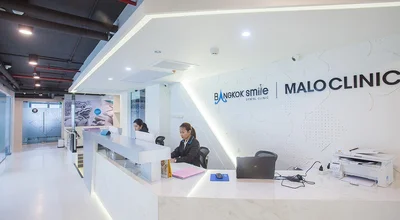
Bangkok Smile Dental Clinic
Multi-branch dental group founded in 2003 and the official Thai partner of the Malo All-on-4 network
View hospital profile
Thantakit International Dental Center
Thailand's longest established dental center, operating in Bangkok since 1945 with more than 40 dentists
View hospital profile
Get a Free Dental Quote in Minutes
Tell us what you need and we'll match you with the right specialist and return real clinic quotes.
- Itemised clinic quotes with no hidden fees
- Matched to a dentist experienced in your specific treatment
- Completely free, even if you decide not to go ahead


Rated 5 stars by our patients
The complete guide to Dental Bonding in Thailand
Everything below is for readers who want the full detail: costs broken down, types and techniques, recovery, risks and safety, and planning your trip.
Dental Bonding Dentists & Clinics in Thailand
Bonding quality depends almost entirely on the dentist's hand skills. Here is what to look for when choosing a clinic in Thailand.
Leading Dental Clinics in Bangkok
Our partner clinics are cosmetic dentistry practices that stock a full range of composite resin shades and opacities. They have the finishing instruments, polishing discs and curing lights needed to produce a refined result. These clinics treat bonding as a skill, not an afterthought.
Experienced Bonding Dentists
The best bonding results come from dentists who take genuine pride in composite artistry. Our partner dentists perform bonding cases daily and many have trained specifically in advanced direct composite techniques. The difference between good and average bonding work is visible: it comes down to colour matching, surface texture and attention to anatomical detail.
What to Look for in a Bonding Dentist
Ask for before-and-after photos of composite bonding work, not just veneers. Look at the surface detail: does the finished bonding blend naturally with the adjacent teeth, or does it look obviously repaired? A good bonding dentist will discuss shade options, layering approach and realistic longevity before starting.
Understanding Your Results
Dental bonding delivers immediate results. Here is what a realistic outcome looks like.
Typical Bonding Results
Bonding fixes visible imperfections: a chipped edge becomes smooth and complete, a gap between teeth is closed, a stained spot is masked, an uneven smile line is evened out. When done well, the repair is invisible. The composite blends with the surrounding tooth so naturally that only the dentist who placed it knows it is there.
What Results Can You Expect?
Expect a meaningful cosmetic improvement, not a full smile transformation. Bonding is targeted; it fixes specific problems on specific teeth. If you need uniform colour, shape and alignment across your whole smile, veneers are the better tool. But for a single chip, a gap or an uneven edge, bonding produces a result you will be genuinely pleased with, in under an hour and at a fraction of the cost.
Dental Bonding Cost in Thailand
Average Cost of Dental Bonding
Dental bonding in Thailand typically costs $100–$200 per tooth. A small chip repair at a single site sits at the lower end. Diastema closure, multi-tooth bonding or polychromatic layering cost more due to the extra chair time and skill involved. Even at the upper end, bonding in Thailand costs less than the starting price at most Western dental practices.
Cost Breakdown
There is no laboratory fee for direct bonding; the entire cost is clinical. You are paying for the dentist's time, the composite material and the clinic overhead. Chair time is the biggest cost variable: a simple edge repair takes 20 minutes while a full polychromatic diastema closure may take an hour or more per tooth.
What Affects the Price?
The number of teeth, the complexity of the sculpting and the technique used are the main variables. Single-shade chip repairs are cheapest. Polychromatic layered bonding across multiple teeth costs more. Wax-up guided cases add a small premium for the diagnostic step. Dentist experience also plays a role, and a specialist in composite artistry may charge more per tooth.
Thailand vs International Price Comparison
Dental bonding in Thailand costs 60–70% less per tooth than equivalent work in the US ($300–$600), Australia (A$300–A$550), and UK (£250–£500). Because bonding has no lab component, the savings come entirely from lower clinical chair-time costs in Thailand.
Types of Dental Bonding
Bonding is a versatile technique applied in different ways depending on what needs fixing. The approach is matched to the specific problem and the forces the bonded area will need to handle.
Direct Composite Bonding
Composite resin is applied freehand to the tooth surface and sculpted in layers to repair chips, reshape contours or cover stains. This is the standard bonding technique, completed chairside in one visit with no lab work involved.
- Completed in a single appointment with instant results
- No enamel removal required in most cases
- Fully reversible and easily repairable if damaged
- Best for: general cosmetic repairs on individual teeth
Edge Bonding
A targeted technique where composite is applied specifically to the biting edge of teeth to repair chips, even out unequal lengths or smooth worn surfaces. It is subtle but effective for front teeth where the edge line matters.
- Ideal for minor chips and uneven tooth edges
- Minimal material needed for an invisible repair
- Quick procedure, often 15–20 minutes per tooth
- Best for: front teeth with chipped or worn incisal edges
Diastema Closure (Gap Bonding)
Composite resin is built up on the sides of adjacent teeth to close a visible gap between them. The material is shaped to widen each tooth proportionally so the result looks natural rather than bulky. An alternative to braces for small to moderate gaps.
- Closes gaps without orthodontics or aligners
- Immediate result completed in one appointment
- Reversible: bonding can be removed if you later pursue braces
- Best for: small to moderate gaps between front teeth
Dental Bonding Techniques
Bonding technique depends on the size of the repair, the tooth's position in the mouth and the forces it needs to withstand. Here is what Thai dentists commonly use.
Freehand Sculpting
The dentist applies and shapes the composite resin entirely by hand, building it up in layers and sculpting the surface to match the natural tooth anatomy. This is the standard technique for most bonding cases and relies heavily on the dentist's artistic skill and experience.
- Most flexible approach, adapting to any repair shape or size
- Allows real-time adjustments to colour, contour and texture
- Quality depends almost entirely on the dentist's hand skills
- Best for: chips, cracks and cosmetic reshaping where artistic control matters
Wax-Up Guided Bonding
A diagnostic wax-up is created first to plan the final shape, then a silicone index is made from that model. The composite is applied using the index as a guide, ensuring the shape matches the approved design precisely. More predictable than freehand for larger or multi-tooth repairs.
- Pre-planned shape reduces guesswork during application
- More consistent results across multiple teeth
- Adds a small cost for the wax-up step but improves predictability
- Best for: diastema closure or multi-tooth bonding where symmetry is critical
Layered Polychromatic Bonding
Multiple shades and opacities of composite are layered to replicate the natural colour transitions in the tooth: opaque dentine tones at the base, translucent enamel tones at the surface. More time-consuming but produces a repair that is virtually undetectable.
- Produces the most natural-looking bonding result
- Mimics the colour depth of real tooth structure
- Requires an experienced cosmetic dentist with colour-matching skills
- Best for: visible front teeth where an undetectable repair is essential
Dental Bonding Recovery Timeline
Immediately After
You can eat and drink right away. There is no numbness unless local anaesthetic was used, and no downtime whatsoever. The composite is fully hardened before you leave the chair and the bonded area is immediately functional.
First 48 Hours
Avoid biting directly into very hard foods with the bonded tooth. The bond is strong but benefits from gentle use during the first couple of days. Avoid heavily pigmented foods and drinks where possible to reduce initial stain absorption.
Week 1
A follow-up appointment may be scheduled to check the bond and make any final adjustments to shape or polish. By now the repair feels completely natural and indistinguishable from the surrounding tooth.
Ongoing
Composite resin can stain over time, so limiting coffee, tea, wine and tobacco helps maintain appearance. Avoid biting pens, nails or hard objects. Professional polishing once or twice a year keeps the surface smooth. With sensible care, dental bonding lasts 3–10 years before needing a touch-up.
When Can You Fly After Dental Bonding?
Immediately if you need to. Dental bonding involves no surgery and no recovery period. The composite is fully hardened before you leave the chair and flying has no effect on the bonded material. Most patients stay a few days to enjoy a follow-up check and some holiday time, but it is not medically necessary.
How Long Does Dental Bonding Last?
Dental bonding lasts 3–10 years with proper care.1 Front teeth bonding that avoids heavy bite forces tends to last toward the upper end of that range. If a bonded tooth chips or stains beyond what polishing can fix, the composite can be repaired or replaced chairside in the same way it was originally applied. No lab work, no waiting.
Bonding vs Veneers: Which Lasts Longer?
Porcelain veneers last 10–15 years and resist staining far better than composite. Bonding lasts 3–10 years and is more prone to surface staining. The trade-off is that bonding costs less, requires no enamel removal, is completed in one visit and is fully reversible. For small, targeted repairs, bonding is often the smarter choice. For a full-smile transformation, veneers deliver a more durable result.
Risks and Safety of Dental Bonding
Dental bonding is one of the safest and most conservative cosmetic dental treatments available. The procedure is reversible, minimally invasive and carries very few risks.
- Surface staining or discolouration of the composite over time
- Chipping or fracture under heavy bite forces or direct impact1
- Temporary dentinal sensitivity where a repair sits close to the pulp or the enamel is etched aggressively
- An inadequate shade match that sets permanently once the composite is cured, correctable only by removing and replacing the bonding
Your dentist will assess the size and location of the repair alongside the forces the bonded area needs to handle. For larger restorations or high-stress areas, a porcelain veneer or crown may be recommended as a more durable long-term solution.
Is Dental Bonding Safe in Thailand?
Yes. Composite bonding is one of the simplest and most predictable cosmetic dental procedures. It has been used worldwide for decades with an excellent safety profile. Our partner clinics use internationally recognised composite resin systems and follow standard bonding protocols. The procedure typically requires no anaesthesia and no drilling.1
How to Protect Bonded Teeth
Avoid biting hard objects like ice, pens, fingernails or packaging. Use a non-abrasive toothpaste to prevent scratching the composite surface. If you grind your teeth at night, a night guard protects both the bonding and your natural teeth. Professional polishing once or twice a year keeps the composite smooth and resistant to plaque accumulation.
When Would You Choose Veneers Instead?
If you need to correct colour, shape and alignment across multiple teeth, porcelain veneers produce a more uniform, longer-lasting and stain-resistant result. Bonding excels at targeted fixes: a single chip, a gap, an uneven edge. If the repair is large or the tooth bears significant bite forces, your dentist may recommend a porcelain veneer or crown for better durability.
Planning Your Trip to Thailand for Dental Bonding
Dental bonding is the easiest cosmetic dental treatment to fit into any Thailand trip. It takes under an hour and has no recovery.
How Long to Stay in Thailand
A stay of 3–5 days is more than enough for dental bonding. The treatment itself takes 30–60 minutes per tooth and is completed in a single visit. The extra days cover a pre-treatment check, a follow-up appointment and travel time. Most patients combine bonding with a holiday or other dental work.
What Is Included in a Dental Trip
Your coordinator schedules appointments and handles clinic logistics. The bonding quote covers consultation, shade matching, tooth conditioning, composite application, sculpting, polishing and follow-up. Flights and accommodation are arranged separately, with coordinator recommendations for nearby hotels if needed.
Adding Bonding to Other Dental Work
Bonding is frequently added to veneer, whitening or implant appointments. It takes minimal extra time and the cost is modest. If you spot a chipped edge or a gap you have been meaning to fix, mention it to your dentist; it can often be addressed in the same session as your primary treatment.
Related Procedures
Other procedures that address similar goals or conditions, in case one of them is a closer fit for you.
Planning your treatment in Thailand
Independent guides to help you weigh the decision, before you commit to anything.
Common Questions About Dental Bonding
Everything you need to know before your treatment

Medical References
Keep researching with AI
Open this guide in your AI assistant to dig deeper and ask the questions it didn't answer.
Opens in a new tab with this guide already loaded.
Medical disclaimer: This information is for educational purposes only and does not replace professional dental advice. Individual results, recovery times, and suitability vary. Always consult a qualified dentist before making decisions about treatment.
Ready to Get Started?
Speak with our care coordinators for a free, no-obligation consultation and personalised quote.
Speak to Our Team