Gum Contouring in Thailand Your guide to cost, top dentists & hospitals
Your teeth might already be fine. It is the gum line that is throwing everything off.
What Is Gum Contouring?
Also known as: Gummy Smile Fix · Gingivectomy
Gum contouring is a dental procedure that reshapes the gum line by removing or sculpting excess gum tissue. It evens out an uneven gum line, or lowers gums that hide too much of each tooth in a "gummy smile", exposing more of the crown so teeth look longer and better proportioned. It is usually done with a soft-tissue laser under local anaesthetic in about 30 to 60 minutes, and because the tissue does not usually grow back, the result is permanent in most cases.
Often it is not the teeth that look wrong, but the frame of gum around them. A millimetre or two in the wrong place can make teeth seem short or one side look higher. Your dentist maps the new line on your own smile first, so you can see where it will sit before anything changes.
The improvement shows as soon as the tissue is removed, though the final shape settles over three to four weeks as the gums heal. It works best when the cause is genuinely excess gum tissue, so an assessment first confirms that reshaping alone will give the result you want.
It can address a range of concerns, including:
Am I a Good Candidate for Gum Contouring?
The deciding question is not how gummy your smile looks, but what is causing it and how healthy the tissue is.
Periodontists first establish whether excess gum tissue, excess bone or jaw position is producing the gummy appearance.
Excess soft tissue: The ideal case. When gum tissue simply covers too much of the tooth crown, laser contouring alone resolves it.
Bone involvement: If the bone crest sits too high, crown lengthening with bone reshaping is needed rather than soft-tissue contouring alone.
Skeletal causes ruled out: A gummy smile driven by jaw position or muscle activity will not be fixed by reshaping gum tissue, which is exactly what the X-rays and assessment are there to catch.
Reshaping is only performed on healthy tissue, so periodontal condition is assessed before any laser touches the gum.
No active disease: Periodontal disease, deep gum pockets or inflammation is treated and settled before any cosmetic reshaping.
Enough tissue to work with: A very thin gum biotype limits how much can be removed without exposing root surfaces, and may rule the procedure out.
Healing capacity matters: Smoking impairs gum healing and increases the risk of recession after surgery, so it is raised directly at consultation.
A full workup first: Pocket measurements, X-rays and bone-level evaluation all precede the choice of technique.
The change is permanent and works within fixed proportions, so the planning matters more than the procedure itself.
Permanent by definition: Removed gum tissue does not regrow, which is why precise planning of how much to take matters so much.
Proportion, not maximum exposure: The target is a natural tooth-to-gum ratio of roughly 75-80% width to length, not the longest teeth possible.
A settling period: The improvement is immediate, but the final contour takes three to four weeks to mature, and minor early asymmetries often self-correct. Occasionally a small touch-up is needed.
Who is not suitable for gum contouring?
- Active periodontal disease, deep gum pockets or inflammation until treated
- A gummy smile caused by jaw position or muscle activity rather than excess tissue
- Very thin gum biotype with too little tissue to reshape safely
- Smoking you are not willing to address, given impaired gum healing and recession risk
- Uncontrolled diabetes or unmanaged blood thinners, which impair healing and raise bleeding risk until addressed with your doctor
- Current or past bisphosphonate or antiresorptive drug use, especially for crown lengthening, given the risk of jaw osteonecrosis
Pricing
How Much Will Gum Contouring Cost in Thailand?
What gum contouring costs at accredited hospitals in Thailand, and what your final quote depends on.
Get your exact price
Tell us what you're considering and we'll send a personalised quote from accredited hospitals within 24 hours.
Get my free quoteTypical prices in Thailand
Typical ranges based on recent hospital quotes. Your exact price depends on the hospital and how complex your case is, and is confirmed at your teleconsultation.
Gum Contouring
Both prices cover the whole reshaping, typically across the six to ten teeth that show when you smile, and whether bone needs touching is what moves the figure.
| Laser gum contouring, soft tissue only The usual choice, reshaping gum alone and healing fastest | $200 to $300 ฿6,800 to ฿10,200 |
| Crown lengthening with bone reshaping Bone is trimmed as well, so recovery takes longer | $300 to $400 ฿10,200 to ฿13,600 |
Get your exact price
Tell us what you're considering and we'll send a personalised quote from accredited hospitals within 24 hours.
Clinics Trusted for Gum Contouring
From internationally accredited flagships to dedicated specialist clinics, these are the kinds of facilities where international patients have this procedure.
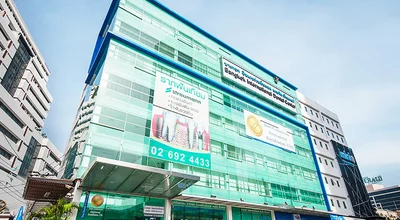
Bangkok International Dental Center
Thailand's first JCI-accredited dental center with more than 70 specialist dentists
View hospital profile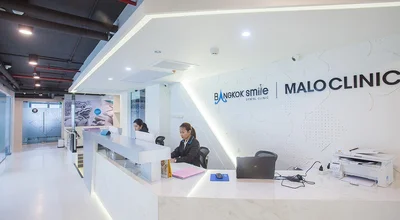
Bangkok Smile Dental Clinic
Multi-branch dental group founded in 2003 and the official Thai partner of the Malo All-on-4 network
View hospital profile
Thantakit International Dental Center
Thailand's longest established dental center, operating in Bangkok since 1945 with more than 40 dentists
View hospital profile
Get a Free Dental Quote in Minutes
Tell us what you need and we'll match you with the right specialist and return real clinic quotes.
- Itemised clinic quotes with no hidden fees
- Matched to a dentist experienced in your specific treatment
- Completely free, even if you decide not to go ahead


Rated 5 stars by our patients
The complete guide to Gum Contouring in Thailand
Everything below is for readers who want the full detail: costs broken down, types and techniques, recovery, risks and safety, and planning your trip.
Gum Contouring Specialists & Clinics in Thailand
Gum contouring sits at the intersection of periodontics and cosmetic dentistry. The best results come from specialists who understand both disciplines.
Leading Dental Clinics in Bangkok
Our partner clinics have dedicated periodontal departments equipped with diode and erbium lasers, digital radiography and the diagnostic tools needed for accurate bone-level assessment. They handle gummy smile corrections as a core service, often coordinated with the cosmetic dentistry department for patients combining gum work with veneers.
Experienced Periodontists
Our partner periodontists are registered with the Thai Dental Council and many hold postgraduate qualifications in periodontics from accredited Thai or international universities. They understand the aesthetic dimension of gum contouring, not just the surgical one: proportion, symmetry and how the gum line frames the teeth.
What to Look for in a Gum Contouring Specialist
Ask whether the specialist has laser equipment or uses a scalpel technique. Look for before-and-after photos of gummy smile corrections, paying attention to the symmetry and proportion of the finished gum line. A good specialist will assess your bone levels before recommending a technique, not just offer laser contouring as a default answer for every case.
Understanding Your Results
Gum contouring results are visible immediately, with the final contour settling over three to four weeks. Here is what to expect.
Typical Gum Contouring Results
The most dramatic improvements are in patients with obvious gummy smiles. Removing even a few millimetres of excess tissue can fundamentally change how the smile looks. The teeth appear longer, more defined and better proportioned. In patients with an asymmetric gum line, contouring evens out the heights so all teeth look the same length.
What Results Can You Expect?
You will see a clear improvement immediately after the procedure. The tissue looks slightly swollen and red initially, but the new gum heights are already apparent. Over three to four weeks, the tissue matures, the colour returns to healthy pink, and the margins settle into their final position. The result is a symmetrical, proportionate frame for your teeth that looks entirely natural.
Gum Contouring Cost in Thailand
Average Cost of Gum Contouring
Gum contouring in Thailand typically costs $200–$400 for the full procedure, depending on the number of teeth involved and whether bone reshaping is needed. Laser soft-tissue contouring on six to ten upper teeth sits at the lower end. Crown lengthening with osseous surgery costs more due to the surgical complexity and longer appointment time.
Cost Breakdown
The fee covers the periodontist or dentist's time, local anaesthesia, laser or surgical equipment use, post-operative care supplies (antiseptic rinse, medications if needed) and follow-up appointments. There is no lab component. The cost is primarily clinical skill and chair time.
What Affects the Price?
The technique is the biggest variable. Laser soft-tissue contouring is quicker and less expensive than crown lengthening with bone reshaping. The number of teeth treated affects the total: a full upper arch costs more than two or three teeth. If gum contouring is combined with veneers, the total package may be discounted.
Thailand vs International Price Comparison
Gum contouring in Thailand costs 60–70% less than equivalent treatment in the US ($600–$1,200), Australia (A$550–A$1,100), and UK (£500–£1,000). The equipment and techniques are the same; Thai periodontists use the same laser systems and surgical protocols as their Western counterparts.
Non-Surgical Alternatives to Gum Contouring
For a gummy smile, the best-known non-surgical alternative is botulinum toxin (Botox) injected into the muscle that lifts the upper lip. By relaxing that muscle, the lip is not pulled as high when you smile, so less gum shows. It involves no cutting and no recovery, and it can be a sensible option when the cause is genuinely an overactive lip muscle rather than the gums themselves.
The limits are significant, though. Botox does nothing to the gum line itself, so it cannot help when excess gum tissue or a high bone crest is what hides the tooth. It is also temporary: the effect fades over roughly three to four months, so it needs repeating indefinitely to maintain6, and the look can be hard to control precisely. It is a way to manage a muscle-driven gummy smile, not to reshape the gums.
When the cause is excess gum tissue or short-looking crowns, which is most cases, contouring is what actually changes the frame of gum around the teeth, and the result is permanent because the reshaped tissue does not grow back. The assessment described above is what establishes which cause you have, so reshaping is recommended only when it is the route that will genuinely fix the problem.
Types of Gum Contouring
The approach depends on how much reshaping is needed and whether the underlying bone is contributing to the problem. Soft-tissue contouring alone solves most cases, but some patients need bone adjustment too.
Laser Gum Contouring
A soft-tissue dental laser (diode or erbium) precisely removes or reshapes excess gum tissue. The laser cuts and cauterises simultaneously, producing minimal bleeding, reduced discomfort and faster healing than traditional scalpel techniques. This is the standard approach for most cosmetic gum reshaping.
- Highly precise control over tissue removal and gum margin placement
- Minimal bleeding and reduced post-operative swelling
- Faster early healing than scalpel work; the contour settles fully over three to four weeks
- Best for: cosmetic gum reshaping where bone levels are normal
Electrosurgery Contouring
A fine electrode uses radiofrequency energy to sculpt gum tissue. Like laser treatment, electrosurgery provides good precision and haemostasis. It is a well-established alternative used by periodontists and cosmetic dentists where laser equipment is not available.
- Effective for soft-tissue recontouring with good bleeding control
- Widely available and clinically proven
- Slightly longer healing than laser in some cases
- Best for: clinics using established electrosurgical systems instead of laser
Crown Lengthening (Osseous Surgery)
When excess bone as well as gum tissue causes the gummy appearance, a small amount of bone is reshaped alongside the soft tissue. This is a more involved procedure performed by a periodontist, necessary when soft-tissue contouring alone would not achieve adequate tooth exposure.
- Addresses both bone and soft tissue for comprehensive correction
- Required when the bone crest sits too high for gum reshaping alone
- Gum surface settles in three to four weeks, but the underlying bone heals more slowly over several months
- Best for: cases where bone level is the primary cause of short clinical crowns
Gum Contouring Techniques
Technique selection is driven by the anatomy: how thick the gum tissue is, where the bone sits, and how much reshaping is needed. Here is what Thai clinics use and when.
Diode Laser Sculpting
A diode laser at 810–980 nm wavelength is used to cut and cauterise gum tissue simultaneously. The dentist traces the desired gum line with the laser fibre, removing excess tissue with sub-millimetre precision. This is the most common technique for cosmetic gum reshaping in Thailand.
- Sub-millimetre precision for accurate gum line placement
- Cauterises as it cuts, virtually bloodless procedure
- Promotes faster epithelial healing than scalpel techniques
- Best for: most cosmetic gum contouring cases involving soft tissue only
Erbium Laser Technique
An erbium laser operates at a wavelength absorbed by water in soft tissue, allowing precise ablation with minimal thermal damage to surrounding areas. Some periodontists prefer erbium lasers for cases where bone is also being reshaped, as the wavelength can address both tissue types.
- Minimal thermal damage to adjacent tissue
- Can address both soft tissue and bone in crown lengthening cases
- Slightly more expensive due to specialised laser equipment
- Best for: crown lengthening where both gum and bone need reshaping
Scalpel with Electrocautery
Traditional surgical technique using a scalpel for tissue removal and electrocautery for haemostasis. Offers excellent tactile control for the periodontist. Some specialists prefer this approach for crown lengthening cases requiring bone access.
- Maximum tactile control for the surgeon
- Well-established technique with decades of clinical evidence
- Slightly longer recovery than laser due to wider zone of tissue handling
- Best for: complex crown lengthening procedures requiring direct bone access
Digital Smile Design Planning
Before any tissue is touched, the dentist photographs your smile and maps the proposed new gum line digitally, against ideal tooth proportions. You see a preview of where the margin will sit and how each tooth will look before treatment begins, and that plan guides the laser or scalpel work. It is a planning method rather than the cut itself, used to make the contouring precise and predictable rather than freehand.
- Maps the new gum line on a photo of your own smile before treatment
- Lets you preview and agree the result before anything is removed
- Guides the laser or scalpel to the planned margin for symmetry
- Best for: anyone wanting to see and approve the gum line before reshaping
Gum Contouring Recovery Timeline
Days 1–2
Mild soreness and swelling around the treated gums are typical. Over-the-counter pain relief and cold compresses manage discomfort effectively. Eat soft, cool foods and avoid anything spicy, acidic or crunchy. Gentle brushing around the treated area with a soft toothbrush.
Days 3–5
Swelling subsides and the gums begin to heal. You can return to a softer normal diet, avoiding hard or sharp foods that could irritate the healing tissue. Use the prescribed antiseptic rinse as directed. The new gum line is already becoming visible.
Weeks 1–2
Gum tissue has healed significantly and the new contour is clear1. Most patients feel comfortable smiling confidently at this stage. A follow-up appointment confirms healing is progressing well and no touch-up is needed.
Weeks 3–4
Healing is complete. The gum tissue has matured and your new gum line is fully settled. Your teeth appear longer, more even and proportionally balanced. The result is permanent; the reshaped tissue will not regrow.
When Can You Fly After Gum Contouring?
Most patients can fly home 5–7 days after laser gum contouring, once a follow-up has confirmed the tissue is healing well. Crown lengthening cases may benefit from staying an extra day or two. Flying itself has no effect on healing gums, but having access to your dentist during the first week provides reassurance.
When Can You Eat Normally?
Soft foods for the first three to five days, then a gradual return to normal eating as comfort allows. Avoid spicy, acidic and crunchy foods during the initial healing phase. By week two, most patients eat without restrictions. The key is protecting the healing tissue from mechanical irritation during the first few days.
When Will You See the Final Result?
You see an immediate improvement as soon as the excess tissue is removed. However, the final contour takes three to four weeks to settle as the tissue matures and the margin stabilises. Minor asymmetries visible at one week often self-correct as healing progresses. The result is permanent once healing is complete.
Will Gum Contouring Hurt?
Gum contouring is done under local anaesthetic, so you stay fully awake and aware throughout. Your periodontist numbs the gum and surrounding area, and you simply sit comfortably while the laser or instrument does its work. There is no need to be put to sleep for a procedure this short and this localised, and you can talk to your dentist the whole way through. Because the standard procedure uses local anaesthetic only, you are safe to drive yourself back to your hotel straight afterwards and do not need anyone to accompany you; if you opt for light sedation, arrange a lift, as you should not drive for the rest of that day.
Once the area is numb you feel pressure and movement but no pain. Most people are surprised by how quick and undramatic it is, usually 30 to 60 minutes from start to finish. If you are anxious about dental treatment, mention it at your assessment; clinics can offer light sedation or simply more time and reassurance to keep you relaxed, depending on what suits you.
Afterwards, as the numbness wears off, expect mild soreness and a little swelling around the treated gums for two to three days. It is easily managed with over-the-counter pain relief and cold compresses, and laser techniques tend to leave less discomfort than scalpel work. It is more tender than truly painful, and it settles quickly.
Risks and Safety of Gum Contouring
Gum contouring is a safe, routine periodontal procedure, particularly when performed with laser technology. Complications are uncommon but worth understanding before you proceed.
- Temporary soreness and swelling lasting two to five days
- Minor bleeding at the treatment site in the first 24 hours
- Infection at the treatment area (rare with proper aftercare)
- Slight gum recession over time beyond the intended contour
- Asymmetric results requiring a minor touch-up procedure
- Temporary tooth sensitivity as more crown surface is exposed
A thorough periodontal assessment before treatment (including gum pocket measurements, X-rays and bone level evaluation) determines the most appropriate technique and identifies any issues that could complicate healing.
Is Gum Contouring Safe in Thailand?
Yes. Laser gum contouring is a routine procedure performed daily in Thai dental clinics. Our partner periodontists use the same laser systems and surgical techniques as specialists in the UK, US and Australia. The laser's precision and cauterisation properties actually reduce risk compared to traditional scalpel methods.
How to Ensure the Best Outcome
Proper diagnosis is the critical step. Your periodontist needs to determine whether the gummy appearance is caused by excess gum tissue, excess bone, or a skeletal jaw position. Soft-tissue contouring alone will not fix a skeletal cause. A thorough assessment with X-rays identifies the right approach and prevents underwhelming results.
Is the Change Permanent?
Yes. In most cases the result is permanent. Rarely, gum tissue can regrow1, which is why precise planning of how much tissue to remove matters; where the bone crest sits high, removing a small amount of bone reduces the chance of regrowth. The target is a natural-looking tooth-to-gum ratio (roughly 75–80% width-to-length), not maximum tooth exposure. A good periodontist knows where to stop.
Planning Your Trip to Thailand for Gum Contouring
Most patients need 5–7 days in Thailand for gum contouring. Here is how to plan your visit.
How Long to Stay in Thailand
Plan for 5–7 days. Day one covers the periodontal assessment and treatment planning. The procedure is typically performed on day two or three. A follow-up appointment three to five days after treatment confirms healing is on track. If you are combining gum contouring with veneers, allow 10–14 days for the complete plan.
What Is Included in a Dental Trip
Your coordinator manages scheduling, clinic logistics and communication. The treatment quote covers consultation, periodontal assessment, the gum contouring procedure, local anaesthesia, aftercare supplies and follow-up appointments. Flights and accommodation are arranged separately, with coordinator assistance for hotel recommendations near the clinic.
Combining with Veneers or Whitening
Gum contouring is frequently done as a first step before veneer placement or teeth whitening. Reshaping the gum line first ensures veneers sit at the right height and proportion. If combining treatments, gum contouring is done first to allow initial healing before veneers are prepared. Your coordinator sequences the appointments for optimal results.
Related Procedures
Other procedures that address similar goals or conditions, in case one of them is a closer fit for you.
Planning your treatment in Thailand
Independent guides to help you weigh the decision, before you commit to anything.
Common Questions About Gum Contouring
Everything you need to know before your treatment

Medical References
- Gum Contouring Surgery, Recovery and What To Expect (Cleveland Clinic)
- Effects of smoking and vaping on oral health (Better Health Channel)
- Gum Recession Causes, Prevention, Surgery and Treatment (Cleveland Clinic)
- Alendronate Drug Information (MedlinePlus)
- Oral Health Problems and Diabetes (Cleveland Clinic)
- Botox Botulinum Toxin, Results and Side Effects (Cleveland Clinic)
Keep researching with AI
Open this guide in your AI assistant to dig deeper and ask the questions it didn't answer.
Opens in a new tab with this guide already loaded.
Medical disclaimer: This information is for educational purposes only and does not replace professional dental advice. Individual results, recovery times, and suitability vary. Always consult a qualified dentist before making decisions about treatment.
Ready to Get Started?
Speak with our care coordinators for a free, no-obligation consultation and personalised quote.
Speak to Our Team